The 18th century began in Spain with the death of the last monarch of the House of Habsburg, Charles II, and the accession to the throne of Philip V, marking the beginning of the Bourbon dynasty’s reign. His recognition as King of Spain was secured following the War of the Spanish Succession (1701–1713), which culminated in the signing of the Treaties of Utrecht and subsequent agreements between the European powers.
The arrival of the Bourbons marked the beginning of a period of profound political, administrative, economic and cultural transformation. Advised by reformist and Enlightenment ministers, the new monarchs promoted changes in the organisation of the State, trade and colonial administration. The gradual process of imperial decline would be partially alleviated during this period, although attempts to preserve the hegemony and glory of previous eras would ultimately fail to reverse its course.
The Spanish Mixed Doctrine: A New Fencing Art Between Two Worlds
It is precisely within this period of great change that we must place the emergence of a new approach to fencing in Spain: the Spanish Mixed Doctrine.
The dynastic transition from the Habsburgs to the Bourbons would transform not only the structures of power, but also the tastes, customs and education of the elites. Spanish nobility would gradually become immersed in French culture, adopting its fashions, etiquette and educational practices. Within this process of French cultural influence, fencing would occupy a prominent place.
Little by little, the wealthier sectors of society began bringing in foreign fencing masters to train the new generations. Along with them came a new weapon: the French sword, known in Spain as the espadín, and referred to as the épée within the French tradition. Its lightness, proportions and technical possibilities would soon lead to its widespread adoption as a standard part of every gentleman’s arsenal.
However, the introduction of these new fashions did not immediately bring about the disappearance of the Spanish tradition. Throughout much of the 18th century, the characteristic cup-hilt sword could still commonly be seen in the streets and at court, frequently accompanied by its left-hand dagger. Both weapons coexisted for decades, although the presence of the cup-hilt sword gradually declined as the century progressed.
It is within this coexistence of tradition and modernity that we must seek the origins of the Spanish Mixed Doctrine.
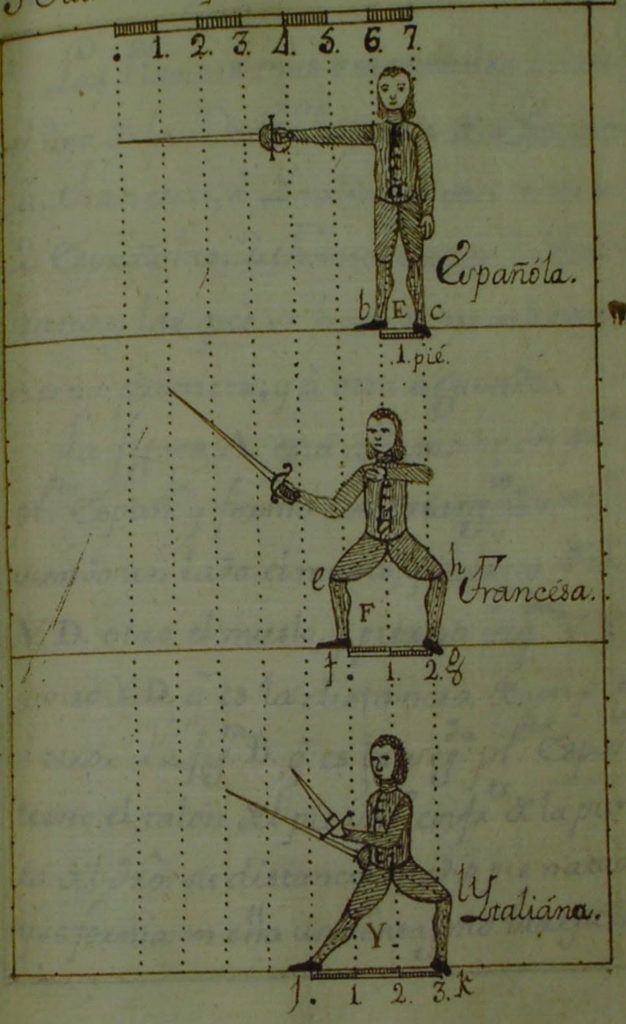
This new form of fencing emerged as an offshoot of the already established Verdadera Destreza, taking its structure and philosophy as its backbone while incorporating part of the technical repertoire derived from the Italian and French doctrines. It was not simply a matter of replacing the old Spanish school with the new European approaches, but rather a process of synthesis in which elements from different traditions gradually converged into a distinctive system.
Thus, whether using the cup-hilt sword or the new French sword, or espadín, we find a form of fencing that combined elements of both the old and the new. New stances, guards and a more refined sense of timing were brought together with more aggressive and athletic physical techniques, while the characteristic circular footwork, methods of encircling the opponent and philosophical principles of the Spanish School remained essential components of its identity.
The Spanish Mixed Doctrine therefore represented a transitional moment between two worlds: that of the Hispanic tradition of Verdadera Destreza and that of the new European schools beginning to dominate the fencing halls.
A distinctive synthesis, born out of a period of dynastic and cultural transformation, which sought to preserve the identity of Spanish fencing while adapting to the new technical and social demands of the 18th century.
Its existence, however, would be relatively short-lived. With the gradual expansion and consolidation of the French school, this particular path in the development of Spanish fencing would eventually disappear, absorbed by a tradition that would ultimately prevail throughout the European fencing scene.
The Spanish Mixed Doctrine would thus remain a remarkable curiosity in the history of fencing: a testament to a time when Spanish tradition and the new European approaches coexisted, clashed and, ultimately, merged in the search for a new way of fighting.
The work I have carried out centres on its founder, Maestro Rodríguez del Canto