The Spanish Mixed Doctrine: A New Form of Fencing Between Two Worlds
An 18th-century Spanish fencing style that blends French, Italian and Spanish traditions into one practical doctrine.
The 18th century began in Spain with the death of the last monarch of the House of Habsburg, Charles II, and the accession to the throne of Philip V, marking the beginning of the reign of the Bourbon dynasty. His recognition as King of Spain was secured following the War of the Spanish Succession (1701–1713), which culminated in the signing of the Treaties of Utrecht and subsequent agreements between the European powers.
The arrival of the Bourbons marked the beginning of a period of profound political, administrative, economic and cultural transformations. Advised by reformist and Enlightenment ministers, the new monarchs introduced changes to the organisation of the State, trade and colonial administration. The gradual process of imperial decline would be partially mitigated during this period, although attempts to preserve the hegemony and glory of previous centuries would ultimately fail to reverse its course.
It is precisely within this period of great change that we must place the emergence of a new approach to fencing in Spain: the Spanish Mixed Doctrine.
The dynastic transition from the Habsburgs to the Bourbons would transform not only the structures of power, but also the tastes, customs and education of the elites. Spanish nobility would gradually become immersed in French culture, adopting its fashions, etiquette and educational practices. Within this process of French cultural influence, fencing would occupy a prominent position.
Little by little, the wealthier sectors of society began bringing in foreign fencing masters to instruct the new generations. Along with them came a new weapon: the French sword, known in Spain as the espadín and referred to in the French tradition as the épée. Its lightness, proportions and technical possibilities would soon secure its place among the standard weapons carried by every gentleman.
However, the adoption of these new fashions did not mean the immediate disappearance of the Spanish tradition. Throughout much of the 18th century, the characteristic cup-hilt rapier could still commonly be found in the streets and at court, frequently accompanied by its left-hand dagger. Both weapons coexisted for decades, although the presence of the cup-hilt rapier gradually declined as the century progressed.
It is within this coexistence of tradition and modernity that we must seek the origins of the Spanish Mixed Doctrine.
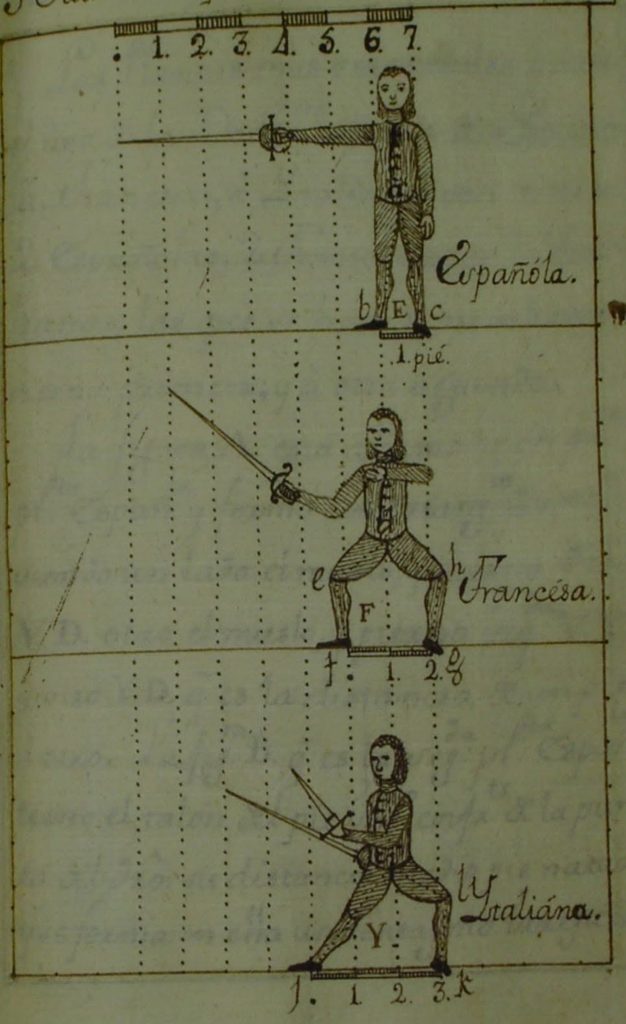
This new approach to fencing emerged as an offshoot of the already established Verdadera Destreza, taking its structure and philosophy as its backbone while incorporating elements of the technical repertoire of the Italian and French doctrines. It was not simply a matter of replacing the old Spanish school with the new European currents, but rather a process of synthesis in which elements from different traditions eventually converged into a distinctive system.
Thus, whether using the cup-hilt rapier or the new French sword, the espadín, we find a form of fencing that combined elements of both the old and the new. New stances, guards and a more refined understanding of timing came together with a more aggressive and athletic approach to physical training, while the characteristic circular footwork, methods of encircling and controlling the opponent, and philosophical principles of the Spanish School continued to form an essential part of its identity.
The Spanish Mixed Doctrine therefore represented a transitional moment between two worlds: that of the Hispanic tradition of Verdadera Destreza and that of the new European schools that were beginning to dominate the fencing halls.
It was a distinctive synthesis, born out of a period of dynastic and cultural transformation, which sought to preserve the identity of Spanish fencing while adapting to the new technical and social demands of the 18th century.
Its existence, however, would be relatively short-lived. With the gradual expansion and consolidation of the French school, this particular path in the development of Spanish fencing would eventually disappear, absorbed by a movement that would ultimately prevail throughout the European fencing scene.
The Spanish Mixed Doctrine would thus remain a unique curiosity in the history of fencing: a testament to a period in which Spanish tradition and the new European currents coexisted, clashed and ultimately merged in the search for a new way of fighting.