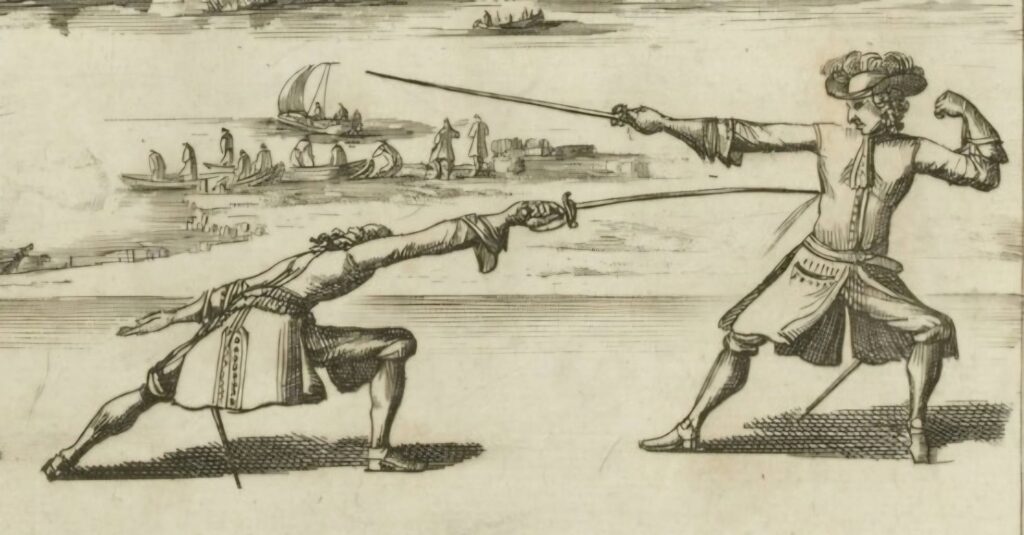
French School
The French tradition reached its peak in the 18th century and shaped modern fencing. Learn: foil and smallsword principles.
The French school of fencing emerged and developed during the 17th and 18th centuries, becoming one of the leading influences in European fencing. Its development was closely linked to the nobility and the French sword, which evolved from the transitional ‘ropera’ swords, particularly during the reign of Louis XIV, when fencing in France acquired its own distinctive gymnastic and martial character, inherited from Italian influences.
This school was notable for its refinement of the ‘fractured timing’ technique and the ‘parry and riposte’ manoeuvres made possible by the new types of sword, the gymnastic nature of its movements, and the use of the primitive foil as a training weapon. It was characterised by a more elastic style based on precision, speed, and control of the eye-hand distance, alongside new, more athletic linear movement patterns.
Furthermore, during this period, technical and pedagogical principles were established which helped to organise fencing as a regulated and systematic discipline, paving the way for modern fencing as we know it today, and laying the foundations for the foil, épée and even sabre fencing practised today. Among its most significant contributions was the publication of treatises that compiled and disseminated its teaching methods throughout the 18th century; these were copied and reproduced across Europe and its colonies.
In short, the French school transformed martial fencing—from its warlike origins—into a leisure or pre-sporting activity, the influence of which remains evident in fencing today.