Italian School
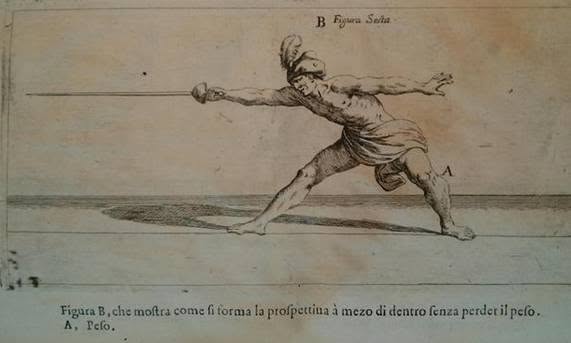
The work of Senese, a 17th-century Italian master of the rapier and the Italian style
The Italian school of fencing in the 17th and 18th centuries was one of the most significant movements in the evolution of European fencing. During the 17th century, it was characterised primarily by the use of the spada, understood in a generic sense as a long, narrow weapon, intended chiefly for combat by means of thrusts.
Italian masters, like their European contemporaries, developed techniques based on precision, speed, control of distance and a balance between attack and defence. However, the Italian tradition had its own distinctive features, particularly in its conception of the timing of attacks and in the way it interpreted and resolved combat situations, thus setting it apart from other traditions such as the Spanish or French.
Among its leading figures were Ridolfo Capo Ferro, author of the treatise Gran Simulacro dell’Arte e dell’Uso della Scherma (1610), Salvator Fabris and Nicoletto Giganti. Nevertheless, we must not overlook the contributions of other masters such as the Marcelli family or Francesco Pavaviccini, nor the figure to whom I have dedicated my study and who is the main focus of this presentation: Alessandro Senese, a member of the Bolognese tradition and author of the work Il Vero Maneggio della Spada, dedicated to Charles Ferdinand, Archduke of Austria.
During the 18th century, Italian fencing continued to evolve, against a backdrop marked by the growing popularity of the épée, a lighter and more manoeuvrable weapon. The technique became increasingly refined, with particular emphasis on speed, control of the point, parries and counter-attacks. Furthermore, fencing retained its importance as part of the education of the nobility and as preparation for duels fought in the name of honour.
In short, the Italian school made a decisive contribution to the evolution of European fencing, developing a technical system based on mastery of timing, distance and precision. Its richness lies not only in its general principles, but also in the diversity of its masters, treatises and regional traditions, amongst which the Bolognese school stands out in particular.