A library of articles, reflections, events and audiovisual content.
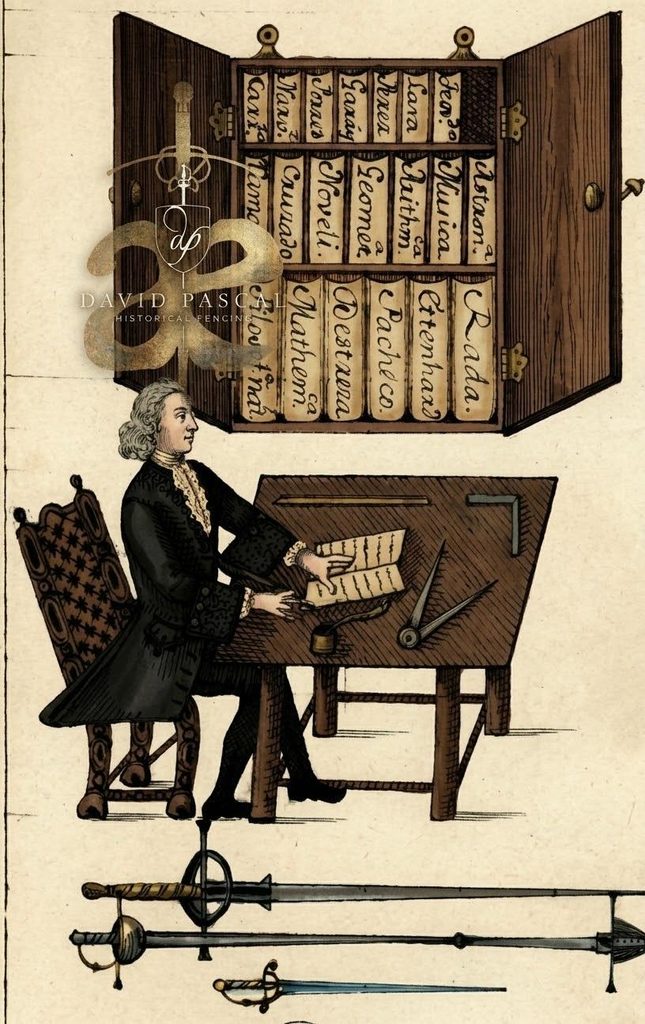
The Transformation of Noble Martial Identity in Eighteenth-Century Spain: Fencing, Education, and the Changing Meaning of the Sword
The changes observed during the eighteenth century affected not merely clothing, weaponry, or fencing techniques, but progressively transformed the ways in which the nobility constructed, understood, and represented its own identity. Nevertheless, this process should not be conceived as an abrupt rupture with the past. Rather, it involved a reconfiguration of an existing identity, one that continued to preserve earlier elements. The nobility still perceived itself as a military estate by right of birth, but increasingly began to express this condition through different cultural and social codes.
The purpose of this article is to establish a historical and conceptual framework for understanding this transformation of noble identity, a process that inevitably influenced martial culture and, consequently, the practice and teaching of fencing during the period.
Traditional noble identity had been legitimised, to a considerable extent, through lineage and blood, honour, the possession and mastery of weapons, personal courage, the ability to fight and prevail, military service, and the defence of family prestige, rights, and property. Within this world, the ability to handle weapons was not merely a technical skill. It constituted an essential component of what it meant to be noble, belonging to a social culture whose internal codes and boundaries are considerably removed from those of our modern understanding. Martial proficiency formed part of an ideal of masculine virtue: a nobleman was expected to be capable of exercising force, defending his honour, and personally responding to threats against himself or his household.
During the eighteenth century, particularly with the consolidation of the Bourbon monarchy, this identity began to reorganise itself around the court, service to the monarch, education, military institutions, and new forms of sociability. The nobleman continued to recognise himself as belonging to his traditional estate, but increasingly came to define himself through additional codes of conduct and distinction. The cult of arms and everything they represented remained firmly established, although the ways in which this attachment was expressed gradually began to change.
Here we encounter a fundamental paradox: the nobility continued to cultivate the art of arms, but its relationship with weapons was changing. The sword did not disappear, nor did it necessarily lose its practical effectiveness; what changed was its social meaning.
This transformation might be understood as a shift from an ideal in which noble status was demonstrated through the personal capacity to exercise violence towards one in which that same capacity could also be expressed through education, technical mastery, discipline, self-control, and institutional service.
Consequently, I would argue against describing this process as the demilitarisation of the nobility. It would be more accurate to speak of a transformation of its martial identity. The nobility remained a social group deeply connected to weapons, but military experience and the mastery of violence were increasingly integrated into institutional structures and established codes of conduct.
This development is particularly interesting in the context of fencing. Fencing instruction did not necessarily lose its martial effectiveness; rather, the context in which that effectiveness was acquired, represented, and legitimised underwent a transformation. Mastery of the sword could continue to constitute an expression of virtue and distinction, but it could also become a form of bodily discipline with additional dimensions. It increasingly involved the control of gesture, distance, timing, force, and personal conduct. These principles had existed for centuries, but during this period they appear to have acquired an increasingly elaborate and, at times, theatrical dimension.
In this respect, fencing occupied an intermediate position between two different cultural spheres. On the one hand, it preserved the memory of a nobility defined by its relationship with weapons and its capacity to exercise violence. On the other, it participated in an emerging culture in which violence was increasingly expected to be controlled, codified, taught, and, in certain contexts, institutionalised.
Within this framework, the foil and its early rules and conventions acquire particular significance. The foil was not simply a new weapon replacing an older one. It also embodied a particular approach to the practice and teaching of fencing, one increasingly governed by formalised conventions and pedagogical principles. The censorship of Perinat’s 1757 work is especially revealing in this regard, since it indicates that the foil was already established among the Spanish nobility. This suggests that Perinat was not creating an entirely new practice of French origin, but rather systematising and teaching a form of fencing that had already achieved a significant degree of social acceptance.
For this reason, the transformation of Spanish fencing during the eighteenth century should not be interpreted simply as a transition from a Spanish school to a French school. At a deeper level, it represented a transformation in the position occupied by fencing within noble culture and identity.
A particularly suggestive relationship can therefore be established between clothing, the body, and weapons. The gradual transition from the golilla to French-style dress did not, in itself, cause a transformation in fencing. Nevertheless, both phenomena can be understood as different manifestations of a broader cultural reconfiguration. The ways in which the nobleman presented himself, behaved in society, and learned to employ and control his own body were all undergoing significant changes.
Clothing, in this sense, represents the most visible dimension of a much deeper process. Fencing allows us to examine this transformation from the perspective of the body itself: how it is positioned, how it moves, how it controls distance, how it regulates force, and how it learns both to exercise and to restrain violence.
It is precisely within this context that Perinat, whom we take as a central case study in this article, becomes particularly significant. His importance lies not merely in introducing or systematising principles associated with the French school of fencing, but in doing so within an institution such as the Royal Academy of Marine Guards (Real Academia de Caballeros Guardias-Marinas), where the teaching of arms was directly connected to the education and formation of a military elite.
Fencing continued to train men capable of handling weapons effectively, but this ability was now integrated into an institutional, technical, and disciplinary system of education. This system, while retaining an understanding of itself as the heir to an older martial tradition, was simultaneously attempting to adapt to the changing military and cultural landscape of contemporary Europe.
Thus, rather than speaking of the disappearance of the warrior nobleman, it would be more appropriate to speak of his transformation. The nobleman continued to regard himself as the heir to a martial tradition, but this martial identity increasingly found expression in ways compatible with the roles of the courtier, the educated gentleman, and the servant of the monarch. Violence did not disappear; rather, its place within noble identity, together with the means through which it could be exercised, legitimised, and controlled, gradually changed.
The central conceptual argument that I would retain from this discussion, particularly in response to those who have characterised this period as one of martial decline in comparison with the preceding centuries, is therefore the following: the warrior identity did not disappear; its mode of expression changed. The adoption of French practices did not necessarily entail the abandonment of the Spanish martial tradition, nor did the apparent predominance of French fencing culture signify the disappearance of the noble cult of arms and violence. Rather, this enduring martial ethos acquired a different form of expression, one increasingly shaped by education, technical refinement, discipline, and institutional structures.
Publicado el 1 de Noviembre de 2026 por David Pascal
On the Nature of the Annervata Thrust
The Annervata thrust must be understood in light of the specific conditions inherent to historical edged-weapon fencing. Its raison d’être cannot be found solely in the geometry of reach, but rather in the combination of circumstances that shaped it and ultimately led to its disappearance: the weight, balance, and length of the weapons of its period; the ever-present possibility of sustaining a wound; the irregular nature of the terrain; even the limitations imposed by footwear and clothing among practitioners of the dominant fencing traditions (every ancient martial art is, to some extent, a victim of geographical inbreeding); and, above all, the uncertainty inherent in any truly martial action.
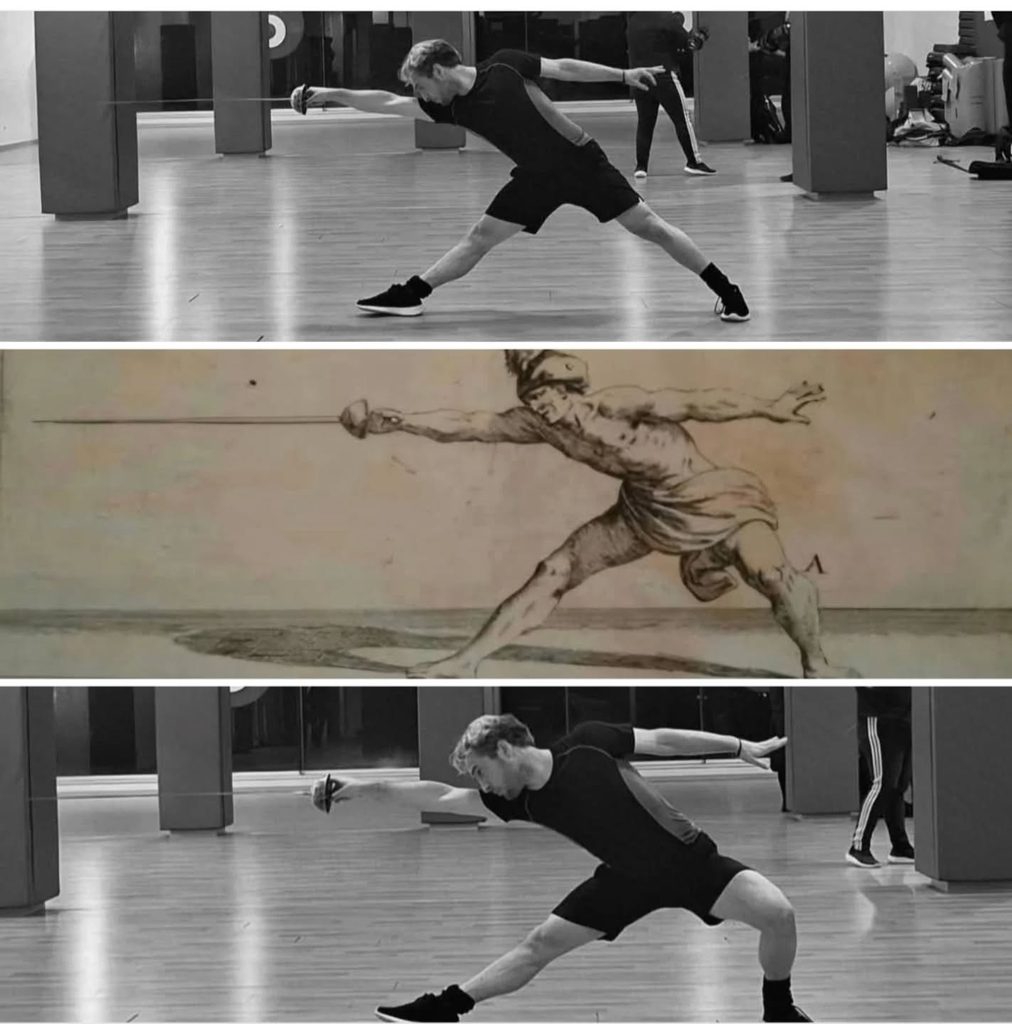
Within this framework, there exists a remarkable variety of thrusting actions which, despite adopting different forms, share a common principle: producing a sudden, forceful extension of the body and weapon without requiring extensive displacement. By way of comparison, it might be understood as a kind of boxing jab: the intention is not to cover a great distance in order to reach the opponent, but rather to concentrate and project the action within an extremely brief interval, causing the thrust to manifest as an explosive release of force at the moment of contact, while minimising exposure.
For this reason, this action should not be confused with a lunge (fondo), whose primary purpose is to gain distance and carry the body towards the opponent’s target, following the specific logic of the lunge itself—a subject we shall not address here. In the Annervata thrust, displacement may be minimal or even entirely absent; what matters is the extension generated and projected by the fencer at the appropriate moment, together with its penetrating power. Its effectiveness therefore lies in both body mechanics and timing, but in a more conservative manner.
This consideration becomes particularly relevant when the thrust is executed in tempo, that is, against the opponent’s preparation or during the execution of their attack. Under such circumstances, the thrust takes on a distinctly counter-offensive character: rather than waiting for the opponent to complete their action before responding, it exploits the moment in which they commit their body, weapon, or measure. The brevity of the action makes it possible to intercept that movement with a high concentration of force at the point of contact.
Nevertheless, it would be limiting to reduce this type of thrust to a merely counter-offensive action. The same mechanical principle can also be employed in offensive and defensive actions, with variations in body alignment, the line of attack, measure, and the way in which body weight is organised in space, as various Italian and, later, Spanish authors point out.
Understood in this way, the Annervata thrust is not a single, fixed technique, but rather a family of actions governed by the same underlying principle: the sudden projection of the weapon through a brief, unplanted extension of the body, executed at the appropriate moment and measure, without necessarily relying on a deep displacement of the body.
Its technical richness stems precisely from the need to adapt to real conditions which, as HEMA practitioners, we could never fully reproduce without falling into self-deception. All we can do is attempt a kind of archaeology of movement: interpreting its biomechanics and trying to apply them within our own simulations.